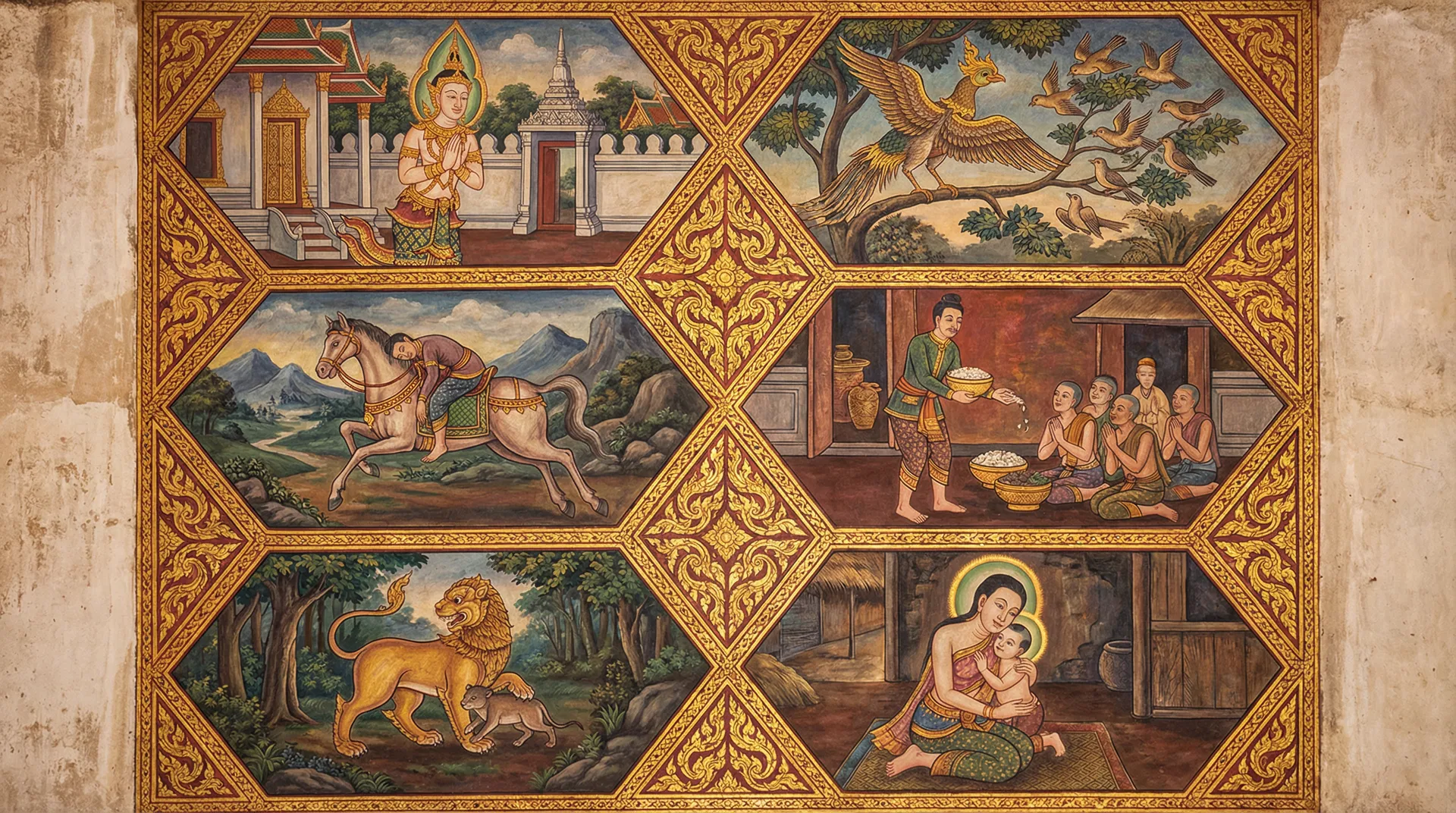
Sutasoma Jataka
Sutasoma Jataka
In a kingdom nestled between whispering mountains and a shimmering sea, there lived a king renowned for his righteousness and his profound devotion to the Buddhist teachings. This king, in a past life, was the Bodhisatta, born as Prince Sutasoma, a young man of unparalleled grace and wisdom. His father, King Pindola, ruled with a gentle hand, but his kingdom was plagued by a terrible curse: a monstrous ogre, a flesh-eating demon named Kalabu, who demanded a daily sacrifice of human flesh to spare the populace from his wrath. The kingdom lived in constant fear, their days shadowed by the looming terror of the ogre's hunger.
Each day, a lottery was held, and one unfortunate soul was chosen to be offered to Kalabu. The cries of mothers, the wails of orphaned children, and the despair of the people echoed through the land. King Pindola, despite his best efforts, could not find a way to defeat the ogre. He had sent his bravest warriors, but they had all met gruesome ends, their bones added to the ogre's gruesome hoard.
Prince Sutasoma, witnessing the unending suffering of his people, could no longer bear it. His heart ached with compassion for the innocent lives lost. He knew that he, as a prince, had a duty to protect his subjects, even at the cost of his own life. He approached his father, his eyes resolute and his voice firm.
'Father,' he said, bowing deeply, 'I cannot stand by and watch our people be devoured by this monster. I have decided to offer myself as a sacrifice to Kalabu. Perhaps my life, willingly given, can bring an end to this reign of terror.'
King Pindola was heartbroken. 'My son,' he pleaded, his voice choked with tears, 'you are the hope of our kingdom. I cannot allow you to face such a fate. There must be another way!'
'There is no other way, Father,' Sutasoma replied gently. 'My destiny, and perhaps the destiny of our kingdom, lies with this sacrifice. Do not grieve, for I go willingly, to save our people.'
The next day, the grim procession began. Prince Sutasoma, dressed in simple white robes, walked calmly towards the ogre's lair, a fearsome cave at the foot of a desolate mountain. The people watched with tears streaming down their faces, their hearts filled with both sorrow and a glimmer of hope that this sacrifice might finally bring them peace.
When Sutasoma arrived at the cave, Kalabu the ogre emerged, his eyes burning with a savage hunger. He was a colossal figure, his skin like rough bark, his teeth like sharpened daggers, and his roar a thunderous sound that shook the very ground.
'So, a prince offers himself!' the ogre bellowed, his voice a rasping growl. 'This is a feast fit for a king… of ogres!'
Sutasoma, without a trace of fear, stood his ground. 'Ogre,' he said, his voice clear and steady, 'I am here to fulfill the bargain. But before you consume me, grant me one request. I wish to engage in a battle of wits, a contest of knowledge. If I win, you shall spare my life and release my people from this terrible tribute. If I lose, you may feast upon me as you wish.'
Kalabu, amused by the prince's audacity, laughed a booming, terrifying laugh. 'A battle of wits? With a mortal? Very well! Your courage is admirable, though foolish. I accept your challenge. Speak your questions, little prince, and prepare to be devoured!'
The contest began. Sutasoma, drawing upon his vast knowledge and sharp intellect, posed questions that challenged the ogre's crude understanding of the world. He asked about the nature of impermanence, the cycle of birth and death, the importance of virtue, and the path to true happiness. Kalabu, accustomed only to brute force and base desires, found himself increasingly bewildered. His answers were crude, selfish, and ignorant.
When it was the ogre's turn, Sutasoma asked him questions about morality, compassion, and the consequences of his actions. Kalabu, unable to comprehend the concepts, grew frustrated. He could not understand why anyone would value kindness over power, or wisdom over strength. His ignorance was laid bare, his cruel nature exposed by the prince's insightful inquiries.
Finally, Sutasoma posed a question that struck at the very heart of Kalabu's being: 'Ogre, what is the greatest source of suffering in the world?'
Kalabu, after a moment of thought, roared, 'Hunger! The insatiable hunger that drives me!'
Sutasoma smiled gently. 'You are mistaken, Ogre. The greatest source of suffering is not hunger, but ignorance. Your hunger drives you to commit terrible deeds, but it is your ignorance of the consequences, your ignorance of the suffering you cause, that truly binds you to a life of misery. And your ignorance of the Dhamma, the teachings of the Buddha, prevents you from finding true peace.'
Kalabu, for the first time in his long, monstrous existence, felt a flicker of understanding. He looked at the young prince, not with hunger, but with a dawning realization. The prince's words resonated with a truth he had never known. He saw the futility of his endless craving, the emptiness of his violent existence.
Defeated not by force, but by wisdom, Kalabu lowered his head. 'Prince Sutasoma,' he rumbled, his voice now tinged with something other than savagery, 'you have won. Your wisdom is far greater than my strength. I have lived a life of darkness, driven by insatiable desires. Your words have shown me a glimpse of light. I shall no longer demand sacrifices. I shall leave this land and seek a path of atonement.'
With that, the great ogre turned and lumbered away, disappearing into the desolate mountains. A profound silence fell over the land, followed by a wave of joyous relief. The people, who had gathered at a distance, erupted in cheers. They had been freed from the ogre's tyranny, not by the sword, but by the wisdom and courage of their prince.
Prince Sutasoma returned to his father's kingdom, not as a sacrifice, but as a hero. His father embraced him, tears of joy and pride streaming down his face. The kingdom celebrated their prince, whose willingness to face death and whose profound understanding had saved them all. From that day forward, Prince Sutasoma was revered not only for his royal blood but for his extraordinary intelligence and his compassionate heart. He eventually ascended to the throne, ruling his kingdom with the same wisdom and kindness that had saved his people from the clutches of the ogre, ensuring an era of peace and prosperity.
— In-Article Ad —
💡Moral of the Story
Wisdom and compassion are more powerful than brute force. True liberation comes from understanding and overcoming ignorance.
Perfection: Wisdom (Panna) and Courage (Virya)
— Ad Space (728x90) —
More Jataka Tales You May Enjoy
 254Tikanipāta
Mātu-posaka-Jātaka
Mātu-posaka-JātakaIn the verdant kingdom of Kosala, where the fields were rich with grain and the ri...
💡 Unwavering filial piety and selfless devotion to one's parents are paramount virtues. Even in the face of unimaginable tragedy and loss, maintaining one's duty and love with integrity is the noblest path.
 92Ekanipāta
Sasa Jataka
Sasa JatakaLong, long ago, in a time when the forests were vaster and the stars shone brighter, ther...
💡 True generosity lies not in giving what is easily spared, but in sacrificing one's own comfort and even life for the sake of others. Selflessness and compassion are the highest virtues.
 174Dukanipāta
Kuṅkuṇavaṅga Jātaka
Kuṅkuṇavaṅga JātakaIn the verdant land of Kasi, a kingdom renowned for its vibrant silks and skilled...
💡 True mastery and excellence are achieved through unwavering patience, dedication, and meticulous attention to detail. Haste and impatience lead to flaws and mediocrity.
141EkanipātaMugapakkha Jataka
The Tale of the Mute Prince In the ancient kingdom of Mithila, ruled a just king named Dhanañjaya. H...
💡 True leadership is demonstrated through actions, courage, and compassion, not merely through eloquent speech.
105EkanipātaSasa Jātaka
The Hare Who Gave His Life In the ancient times, when the moon was young and the stars shone brighte...
💡 Selfless generosity, even to the point of sacrificing one's own life, is the highest virtue. True compassion extends beyond oneself and seeks to alleviate the suffering of others at any cost.
103EkanipātaMora Jātaka
The Golden Peacock's Plea In the heart of a vast and ancient forest, where emerald canopies kissed t...
💡 True beauty and value are best appreciated in their natural state. Possessing something or someone against their will diminishes its essence and leads to suffering, both for the captive and the captor. Freedom and dignity are paramount.
— Multiplex Ad —